
The Logbook
Why a mileage log kept as you drive beats rebuilding it at tax time
If you drive for a private-hire or ride-hailing business as a sole trader, your Self Assessment return depends on records you keep during the year. If you claim for your driving, your mileage records are part of what supports that claim. This article is about when those records need to exist, and why it is easier to write them down as you go.
The dates HMRC publishes
HMRC sets the dates. They repeat every tax year, so the clearest way to read them is with a worked example.
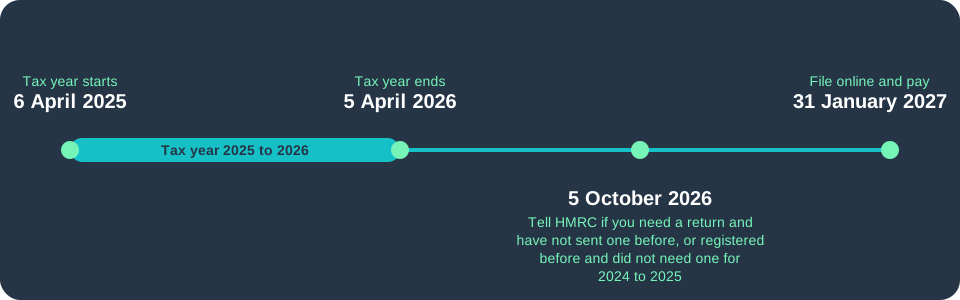
Telling HMRC. The rule is to tell HMRC by 5 October if you need to complete a tax return for the previous year and you have either not sent a tax return before, or registered before but did not need to send one for the year before that. Example: the 2025 to 2026 tax year started on 6 April 2025 and ended on 5 April 2026. For that year, the date is 5 October 2026, and the second condition refers to people who registered before but did not need to send a return for the tax year 2024 to 2025.
If you register after 5 October 2026, HMRC sends a letter or email with a different deadline for your return, which is 3 months from the date on the letter or email. You must still pay the tax you owe by 11:59pm on 31 January 2027.
Filing and paying. For the same example year, an online return has to be submitted by 11:59pm on 31 January 2027, or HMRC applies a late filing penalty. The Self Assessment tax is also due by 11:59pm on 31 January 2027. If you make payments on account, other dates apply; HMRC's page explains them.
HMRC's own page is the place to check the current dates and the exact conditions: Self Assessment tax returns: deadlines.
The records come first
HMRC says sole traders must keep records of business income and expenses for their Self Assessment tax return (Business records if you're self-employed). A mileage log is one way of recording the driving side of that.
The filing date is the deadline for the return. The records are made earlier, during the year. That is where timing matters.
Two ways to build a mileage log
Rebuilt at tax time. You work back through a year of app histories, bank statements and memory. Every journey has to be reconstructed after the fact. Some of it may be missing, and you cannot easily tell which parts.
Kept as you drive. You note each working day as it happens, and the log is complete by the time you need it.
A simple entry for each working day could include:
- the date
- the odometer reading at the start and the end, or the miles driven for work
- one line on what the driving was for
What you need to record depends on your situation. Your accountant can tell you.
Pick a time that suits you, such as the end of each shift or once a week, and keep to it. The point is that the record is written close to the driving, not that it is neat.
What to do next
- 1. Start the log today. It will cover every day from now on.
- 2. Put the dates for your own tax year in your calendar, using the example above as a guide.
- 3. Check HMRC's pages above for the rules that apply to you.
Last checked 1 October 2026. General information, not tax advice. Your accountant or HMRC has the final word.
Drafted with AI help. Every fact is checked against the official sources listed, and a person at SEEKRESOLVE. LTD reads each article before it is published.